There’s a small but telling moment you might’ve experienced—your phone unlocks instantly with your face, even without internet. No loading, no delay. It just works. That quiet speed? That’s edge AI doing its thing.
But then, you ask a voice assistant something complex, and suddenly it leans on the cloud—processing, analyzing, responding with more depth than your device alone could handle.
This back-and-forth between edge and cloud AI isn’t just technical architecture. It’s shaping how real-world systems behave—how fast they react, how private they feel, and sometimes, how reliable they are.
Related readingWhen Customer Support Starts Talking Back Like a Human: Are AI Avatars Actually Working?
What Edge AI Actually Feels Like in Practice
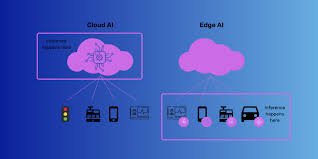
Edge AI lives where the data is created—on your phone, your smartwatch, your car, even factory machines. It processes information locally, without sending everything to a distant server.
And that changes the experience in subtle but important ways.
It’s faster, for one. No dependency on network speed. In scenarios like autonomous driving or industrial automation, that speed isn’t just convenient—it’s critical.
It’s also more private. Sensitive data, like biometric information, can stay on the device instead of being transmitted elsewhere. That’s becoming increasingly important as people grow more aware of data security.
Related readingAI SEO Services in 2026: What’s Actually Changed Since the Hype First Started
But edge AI has limits. Devices can only handle so much processing power. Complex tasks often need more muscle than a local chip can provide.
Cloud AI: The Powerhouse Behind the Scenes
Cloud AI operates at a different scale.
Instead of being limited by device hardware, it taps into massive data centers with virtually unlimited processing capabilities. This allows for deeper analysis, more complex models, and continuous learning from large datasets.
When you upload photos to a platform that organizes them automatically, or when a recommendation engine suggests exactly what you didn’t know you needed—that’s cloud AI working quietly in the background.
Related readingOwning Your Data: Could Personal Data Vaults Finally Change the Privacy Game?
It’s powerful, but not always immediate. There’s latency, network dependency, and sometimes, a sense that your data is traveling further than you might like.
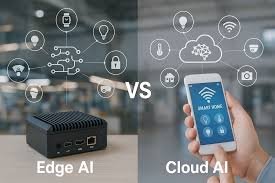
Edge AI vs Cloud AI – real-world applications me kaunsa better hai?
This is the question businesses and developers are actively grappling with—and the answer, frustratingly, is: it depends.
In real-world applications, “better” isn’t absolute. It’s contextual.
For use cases that demand instant response—like self-driving systems, smart surveillance, or real-time health monitoring—edge AI often takes the lead. The ability to process data locally, without delay, makes all the difference.
On the other hand, applications that require heavy computation—like training AI models, large-scale data analytics, or complex natural language processing—are better suited for the cloud.
What’s becoming clear is that the future isn’t about choosing one over the other. It’s about combining them intelligently.
The Rise of Hybrid AI Models
Increasingly, systems are being designed to use both edge and cloud AI together.
Imagine a smart security camera. It might use edge AI to detect motion instantly and trigger alerts. But for deeper analysis—like identifying patterns over time or improving detection accuracy—it sends data to the cloud.
This hybrid approach balances speed and power. It allows devices to act quickly when needed, while still benefiting from the broader capabilities of cloud-based systems.
And honestly, it feels like the most practical path forward.
Where Latency Becomes a Dealbreaker
Latency isn’t just a technical term—it’s a real-world limitation.
In industries like healthcare, manufacturing, or autonomous vehicles, even a slight delay can have serious consequences. Waiting for cloud processing in such scenarios isn’t always an option.
Edge AI steps in here, reducing response time to near zero. Decisions happen where the data is generated, not miles away in a server.
That immediacy is hard to replicate with cloud-based systems alone.
The Cost and Scalability Angle
From a business perspective, the choice between edge and cloud also comes down to cost and scalability.
Cloud infrastructure can scale quickly, handling large volumes of data without requiring physical upgrades on individual devices. It’s flexible, but ongoing costs can add up.
Edge AI, while reducing cloud dependency, often requires more advanced hardware upfront. That can increase initial investment, especially when deploying across multiple devices.
It’s a trade-off—pay as you grow versus invest upfront for independence.
Privacy Isn’t Just a Feature Anymore
There’s a growing awareness around data privacy, and it’s influencing how AI systems are designed.
Edge AI aligns well with this shift. By keeping data local, it reduces exposure and potential risks associated with data transmission.
Cloud AI, while powerful, has to navigate stricter regulations and user concerns. Encryption, compliance, and transparency are becoming non-negotiable.
The balance between convenience and privacy is still evolving, and both approaches are adapting in their own ways.
So, What Does the Future Look Like?
If you zoom out, the debate between edge and cloud AI feels less like a competition and more like a collaboration.
Edge AI brings speed, privacy, and reliability at the point of interaction. Cloud AI brings scale, intelligence, and continuous improvement.
Together, they create systems that are not just functional, but responsive and adaptable.
And maybe that’s the real takeaway.
Final Thoughts
Technology rarely moves in straight lines. It evolves in layers, combining old ideas with new possibilities.
The edge vs cloud AI conversation is a perfect example of that. It’s not about replacing one with the other—it’s about understanding where each fits best.
Because in the end, the goal isn’t to choose sides. It’s to build systems that work—efficiently, intelligently, and in ways that actually make sense in the real world.