A few years ago, “AI SEO” mostly meant content generation tools that helped you produce more text faster. That was the dominant application, and the debate was mostly about whether AI-generated content was acceptable, detectable, or effective.
That conversation feels dated now. Not because content generation stopped being relevant — it didn’t — but because it was always a small part of a much bigger picture that has since come into much sharper focus.
What AI in SEO Actually Encompasses
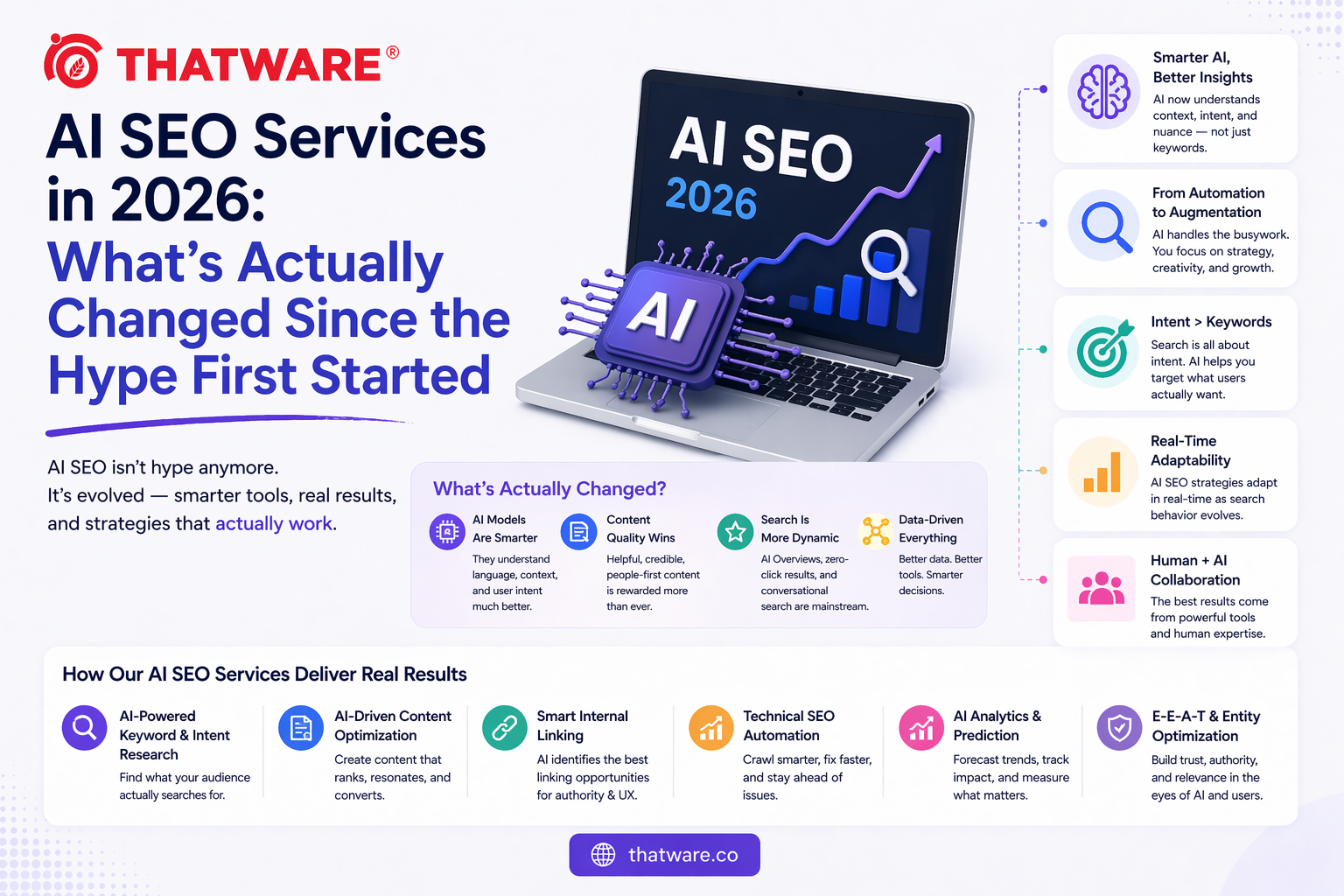
The scope of AI application in search optimization has expanded dramatically. Content generation is one piece. But AI is now being applied to technical SEO auditing, predictive keyword analysis, competitive intelligence, link profile evaluation, content gap identification, SERP behavior modeling, and increasingly to the question of how to optimize for AI systems themselves — since those systems now sit between content creators and users.
Related readingWhen AI Has to Decide Fast: Why the Edge vs Cloud Debate Feels More Real Than Ever
The breadth of that list is worth pausing on. Every major function in SEO now has an AI application that’s meaningfully better than the pre-AI version of that function. That’s not hype anymore. That’s just where the tooling is.
What’s Actually Different in 2026
The shift from 2023-level “AI SEO” to the current state isn’t primarily about more powerful models, though that’s real. It’s about integration and application maturity.
A few years ago, AI tools were mostly standalone — you’d use an AI writing assistant separately from your keyword tool separately from your analytics platform. The insights didn’t talk to each other. The intelligence was siloed.
Related readingWhen Customer Support Starts Talking Back Like a Human: Are AI Avatars Actually Working?
What’s changed is that ai seo services in 2026 increasingly mean integrated AI workflows where data from different sources — crawl data, competitive data, content performance, search behavior, and more — is synthesized by AI systems that can surface insights across that full data picture simultaneously. That integration produces a qualitatively different kind of analysis.
The Content Quality Shift
The content generation debate has landed somewhere interesting. The consensus, to the extent there is one, is roughly this: AI-generated content at scale without meaningful human oversight produces mediocre-to-harmful results. AI-assisted content with strong human editorial direction produces excellent results efficiently.
The agencies and brands that figured out the right human-AI collaboration model for content production earlier are now operating with significant efficiency advantages. They’re producing more content, at higher quality, with faster turnaround, than purely human operations of equivalent size.
That gap is going to continue widening. The organizations still producing content purely through traditional workflows are going to find it increasingly hard to compete on output volume while maintaining quality.
Related readingOwning Your Data: Could Personal Data Vaults Finally Change the Privacy Game?
Technical SEO Applications
The application of AI to technical SEO is less discussed but possibly more impactful. Crawling and indexation decisions, log file analysis, site architecture optimization, structured data implementation — all of these have traditionally required significant manual analysis.
AI systems trained on large datasets of crawl behavior and ranking outcomes can now flag technical issues, prioritize remediation by predicted impact, and identify patterns that human analysts would miss or take much longer to find. For enterprise sites with millions of pages, this isn’t a convenience — it’s a capability that fundamentally changes the speed and quality of technical SEO work.
The AI-for-AI-Optimization Layer
There’s a meta-level to this that’s worth acknowledging. One of the growing applications of AI in SEO is optimizing for AI systems — specifically, making content that performs well in AI-generated search results, AI assistant citations, and generative engine responses.
This is a new and genuinely distinct use case. The question isn’t just “how do we rank in Google?” but “how do we show up well across the ecosystem of AI-mediated information retrieval?” Answering that question well requires understanding how AI systems process and evaluate content — which itself requires AI-powered analysis.
A sophisticated ai seo agency in 2026 is thinking about this full stack. Traditional search ranking, generative engine visibility, AI assistant citation — all of it is part of the optimization landscape, and each requires different but overlapping approaches.
What’s Overrated
Not everything labeled “AI SEO” deserves the label. Content generation tools that produce undifferentiated text at scale, automated link-building schemes using AI-generated outreach, “AI-powered” auditing tools that are really just repackaged traditional crawlers with a chatbot interface — these exist and they don’t deliver the value their marketing claims.
The differentiating question is whether the AI application is producing genuinely better analysis and outcomes, or just doing existing things with a different interface. Real AI-powered SEO changes what’s possible. Cosmetically AI-labeled services just change what it’s called.
Where This Is Going
The trajectory for AI in SEO is toward deeper integration, broader application scope, and increasingly toward the AI-for-AI optimization layer becoming central to the practice. The agencies and practitioners building expertise in that layer now are going to be significantly better positioned as that importance grows.
The hype cycle around AI SEO has largely resolved into a clearer picture: AI in search optimization is real, impactful, and getting more important. The question for businesses is whether their SEO partners are genuinely leveraging it or just marketing it.