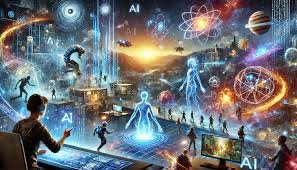
There was a time when game worlds felt… fixed. Carefully designed, beautifully crafted, but ultimately predictable after a while. You learned the map, memorized enemy patterns, and somewhere along the journey, the sense of surprise started fading.
Lately though, something’s shifting—and it’s subtle enough that you might not notice it right away.
Artificial intelligence is stepping into game design, not just as a tool behind the scenes but as a creator of worlds themselves. And that changes things. Not dramatically all at once, but in small, almost invisible ways that slowly reshape how we experience games.
Related readingFrom Passion Projects to Paychecks: How Indie Game Developers Are Finding New Ways to Fund Their Dreams
From Designed Worlds to Living Systems
Traditional games rely heavily on handcrafted environments. Every building, quest, and character is placed intentionally by developers. It’s an art form, no doubt—but it also comes with limits.
AI-generated worlds, on the other hand, introduce variability.
Instead of a fixed map, you get environments that evolve. Landscapes that shift, quests that adapt, and characters that respond differently based on your choices—not just through pre-written scripts, but through systems that can generate new outcomes.
It’s less like exploring a static painting and more like stepping into something… alive.
Related readingPlaying Together, Anywhere: Is Seamless Cross-Platform Gaming Really Within Reach?
The Element of Surprise Comes Back
If you’ve played enough games, you know the feeling of predictability creeping in. You start recognizing patterns. You can almost guess what’s coming next.
AI disrupts that comfort zone.
With procedural generation powered by machine learning, no two playthroughs need to feel identical. A dungeon might rearrange itself, a storyline might branch in unexpected directions, or an NPC might react in a way you didn’t quite see coming.
That unpredictability brings back a kind of curiosity—almost like playing games for the first time again.
Related readingA Guide to Online Number-Based Gambling Terms and Responsible Awareness
AI-generated game worlds player experience ko kaise change kar rahe hain?
It’s a question that sounds technical, but the answer is surprisingly human.
At its core, AI is making games feel more personal.
Instead of everyone sharing the exact same experience, players start encountering slightly different versions of the same world. Your journey becomes yours in a more meaningful way—not just because of the choices you make, but because the game itself adapts around you.
It’s like the difference between reading a story and co-creating one. You’re no longer just following a path; you’re influencing how that path unfolds in real time.
NPCs That Feel Less Like Scripts
One of the more noticeable changes is in how non-playable characters behave.
Earlier, NPCs followed fixed dialogue trees. You’d pick an option, get a response, and move on. After a few interactions, it started to feel mechanical.
AI-driven NPCs, however, can generate responses dynamically. Conversations feel less repetitive, more fluid. Sometimes even a bit unpredictable.
You might ask a question and get a response that feels… oddly natural. Not perfect, not always coherent—but closer to a real interaction than anything scripted.
And that slight imperfection? It actually adds to the immersion.
Endless Content, But at What Cost?
There’s an obvious advantage to AI-generated worlds—scale.
Developers can create massive environments without manually designing every inch. This opens the door to larger, more complex games with seemingly endless content.
But there’s a flip side.
When everything is generated, there’s a risk of losing intentional design. Handcrafted moments—the kind that stay with you long after you’ve finished a game—are harder to replicate through algorithms.
AI can create variety, but meaning? That’s still a bit tricky.
The Balance Between Creativity and Control
Game developers are now walking a fine line.
How much should be generated, and how much should be designed?
Too much AI, and the game might feel directionless. Too little, and you miss out on the dynamic possibilities. The sweet spot seems to lie somewhere in between—where AI enhances the experience without completely taking over.
Think of it as collaboration rather than replacement. Developers set the stage, and AI helps keep the performance fresh.
What This Means for Players
For players, the shift is both exciting and slightly unfamiliar.
You can’t rely on walkthroughs the same way anymore. You can’t assume your experience will match someone else’s exactly. There’s a bit more uncertainty, but also more ownership.
Games start feeling less like products and more like experiences that evolve with you.
And maybe that’s the point.
A Future That Feels Less Predictable
If you step back and look at the bigger picture, AI-generated worlds aren’t just a technical upgrade. They represent a change in how we think about games.
From fixed stories to fluid experiences. From shared paths to personalized journeys.
It’s not perfect yet. There are rough edges, moments where the system feels off or incomplete. But even in its early stages, there’s something compelling about it.
Because at the end of the day, what keeps players coming back isn’t just graphics or mechanics—it’s the feeling of discovery.
And AI, in its own imperfect way, is bringing that feeling back.